Mussels
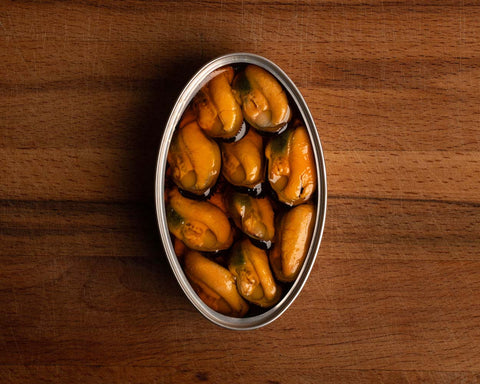
Galician mussels are said to be the best because the estuaries that dot the Galician coast in northwestern Spain are rich in nutrients, have calmer currents and are more temperate than the open sea, conditions that help the bivalves thrive.
Galician canneries like Los Peperetes, Ramón Peña and Real Conservera Española choose to add a PDO or protected designation of origin seal to their tinned mussels because mussels from Galicia have a unique taste that the canneries believe places them in a distinct and covetable category.
When they are rope grown (longline culture), ropes dangle down into the water, tied at intervals to one long horizontal rope buoyed up by floats. Each of the vertical ropes are seeded with spat, or young mussels.
The mussels fasten onto the ropes using byssal threads or ‘beards’ - the tough, sticky, flexible thread has inspired scientists to develop adhesives similar to byssal threads for use in dentistry, when implants are fused to the bone.
It takes 15 months to two years for the mussels to reach maturity and be ready for harvest. When the mussels are the right size and ready to be harvested, a platform is lowered beneath the ropes and they are cut at the top. The platform is then raised to the surface and the mussels are prised from the ropes. This is similar to raft culture, where ropes are hung from rafts that float in the Galician estuaries.
Other areas produce fine mussels too. Fangst blue mussels, for instance, are from the Danish inlet of Limfjord. The Copenhagen-based producer says that the cold waters there ensure that the mussels grow slowly and acquire a fine taste and texture.
Mussels - including farmed ones - are a sustainable source of seafood. They are virtually carbon neutral source of food. These bivalves are filter feeders. Rather than preying on other fish, they feed on plankton and microscopic sea creatures that contain nitrogen and phosphorous, helping to prevent excessive amounts of these nutrients from building up in the water - in other words they filter impurities from the water.
Wild mussels clump together in mussel fields on the ocean bed and create sheltered habitat for other species of fish and shellfish too.
Mussels also indicate how healthy the ocean is. Their behaviour, physiology and the compounds found in their bodies can be monitored by scientists to assess the state of the sea.
More about mussels
- The mussels we stock are blue mussels (Mytilus edulis), Mediterranean mussels (Mytilus galloprovincialis), and New Zealand green-lipped mussels (Perna canaliculus). All three are from the family Mytilidae – which means they are true mussels. The Mediterranean mussels that we stock are harvested in Galicia, and are also known as Galician mussels.
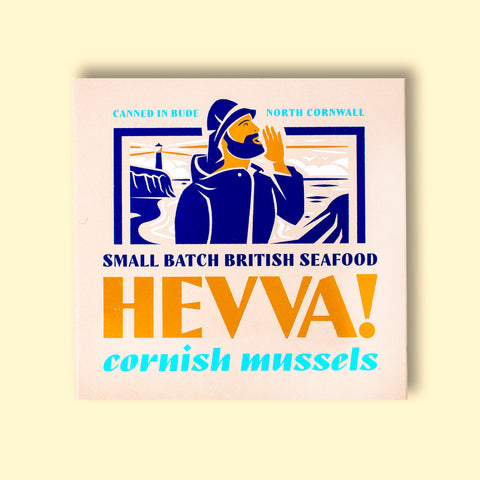
- Fangst and Hevva! work with tinned blue mussels. Los Peperetes, Ramón Peña, Real Conservera and Angelachu can Mediterranean mussels - aka Galician mussels as they are farmed or cultured in the Galician Rías or estuaries. And the whoppers from Angelachu in escabeche are the New Zealand green-lipped mussels.
- Health benefits of tinned mussels: when tinned mussels are preserved fresh their nutrition is the same as fresh mussels. Los Peperetes and Ramón Peña choose to add a Protected Designation of Origin label to their tinned mussels that states they are Galician mussels. As well as meaning the mussels come from the Galician rivers and estuaries, this stamp also indicates that they have been canned within 24 hours of being harvested.
Like oily fish such as sardines, mackerel, anchovies, salmon and herring, mussels are an excellent source of omega-3 fatty acids which are thought to boost brain, eye and heart health and reduce inflammation.
Mussels contain all nine essential amino acids, the molecules that our bodies need to make protein. Essential amino acids are the ones our bodies cannot produce by themselves and we must get from our diet. Mussels are a source of zinc that may boost immunity and improve memory, iron to shield against anaemia and help maintain energy levels, vitamin B12 for nervous system health, red blood cell production and anaemia protection, and phosphorous and calcium for healthy bones and teeth.
- Tinned mussel recipes: a popular Spanish tapas is to enjoy the pickled tinned mussels in escabeche scattered over crisps. The tapas inspired our Crisp Mixto, a sandwich with paprika crisps, tinned mussels and mustard mayonnaise with gherkins.
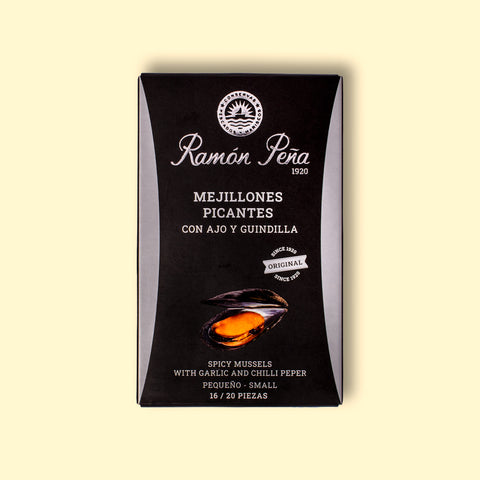
- Even simpler, try the Spanish tinned mussels on a cracker with cream cheese. Or use them to garnish a paella. The Fangst smoked mussels work well in an omelette with some sautéed red pepper and garlic. The Ramón Peña spicy tinned mussels are great with sautéed garlic, deseeded chilli and parsley, on pak choi or baby gem lettuce leaves.